
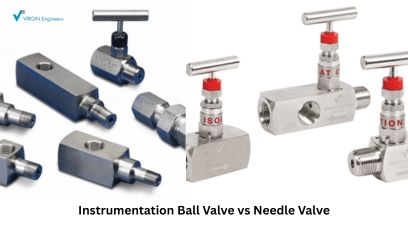
Valves are not passive components in oil and gas operations. They isolate process lines, protect instrumentation from pressure surges, and maintain system integrity during shutdowns and maintenance. Instrumentation circuits carry this responsibility at the point where process media connect to pressure transmitters, flow meters, and analytical instruments. Getting valve selection wrong at these connection points creates measurement errors and unplanned downtime.
Two valve types appear most frequently in oil and gas instrumentation: the ball valve and the needle valve. They both deal with flow control, but they function on different principles and have different purposes. Knowing where each belongs helps engineers improve process safety, system efficiency, and control accuracy. Industries operating in high-pressure and corrosive service conditions depend on a reliable manufacturer to meet the Industrial Requirements of Instrumentation Ball Valves in demanding field applications. The materials, pressure ratings, and end connections specified during manufacturing determine whether a valve holds through years of field service or fails at the first inspection.
Key Differences Between Instrumentation Ball Valve and Needle Valve
Ball valves deliver fast on-off isolation. A quarter-turn moves the ball from fully open to fully closed, with the bore aligned to the pipeline at full open for minimal flow restriction. A well-manufactured instrumentation ball valve achieves a leak rate below 0.1 cc per minute at rated pressure. That clean shut-off performance makes it the standard choice for instrument root valves and emergency isolation points.
Needle valves work differently. A tapered needle advances into a precision-machined seat as the handwheel turns, requiring 6 to 14 full rotations to travel from closed to open. That slow travel allows incremental flow adjustment, which a ball valve cannot replicate. In a calibration gas line feeding an analyser, the operator sets a flow rate of approximately 1.5 litres per minute and holds it there for hours. A needle valve does this reliably. A ball valve does not.
In a refinery pressure transmitter installation, the root valve isolating the transmitter is a ball valve, closing fast during emergencies. The bleed valve in the same manifold is a needle valve, letting the technician vent pressure at a controlled rate before disconnecting the instrument. Valve selection depends on system pressure, required flow control accuracy, and whether the primary need is isolation or regulation.
Applications in the Oil and Gas Industry
- Upstream operations at wellheads and chemical injection skids use instrumentation ball valves at control panel isolation points, where pressures regularly exceed 5,000 PSI. Needle valves handle corrosion inhibitor dosing at controlled millilitre-per-hour rates into the production stream.
- Offshore platforms require compact valve configurations that mount directly to tube fittings. Ball valves suit instrument root connections on topsides. Needle valves are used on gas sampling lines and gauge bleed connections where controlled depressurisation is needed to protect instrumentation and personnel.
- Refineries rely on ball valves rated from -29°C to 232°C for isolation at instrument taps across hydrocarbon and steam service. Needle valves appear in differential pressure circuits on heat exchangers, metering flow through the low-pressure leg for stable DP readings.
- Petrochemical plants handling chlorine compounds, caustic soda, and organic solvents specify both valve types in Hastelloy C276 or Monel 400 rather than standard 316 stainless steel, due to the chemical aggressiveness of the media.
- Gas distribution systems use instrumentation ball valves at meter station isolation points, needle valves for flow regulation, and pilot-operated pressure regulators.
- Instrumentation panels pair ball valves for isolation with needle valves for equalisation and bleed functions within compact manifold blocks. The function of valves in piping panels covers shut-off, pressure isolation, depressurisation sequencing, and calibration bypass. Operational safety across these panels depends on each valve holding position reliably under both static and cyclic pressure.
Role of Instrumentation Ball Valves in Process Control Systems
Process control loops depend on stable isolation at every instrument tap. A leak past a root valve introduces pressure error directly into the transmitter signal, compounding through the control loop. In a separator at tight level margins, a one-PSI measurement offset can cause liquid carry-over into the gas export line.
Instrumentation Ball Valves in Process Control Systems address this by delivering full-bore, bubble-tight shut-off through a single quarter-turn. Integration with compression-type tube fittings keeps connections leak-free at pressures up to 6,000 PSI. Pneumatic actuators and limit switches mount directly onto the valve stem for remote operation from a distributed control system. Virgin Engineers manufactures instrumentation ball valves with cavity-relief body designs that prevent pressure build-up from trapped media, reducing seal blow-out risk during thermal cycling and lowering the maintenance burden across the instrumentation loop.
Advantages of Needle Valves in Precision Applications
Needle valves outperform every other small-bore valve type where the requirement is controlled flow rather than isolation. The tapered seat allows adjustment in increments far smaller than a ball valve can achieve. In gas chromatograph sample conditioning systems, the sample must reach the analyser within 5% of the instrument’s designed inlet velocity. A needle valve holds that setting across the shift without drift.
Calibration systems rely on needle valves to introduce reference pressure at a known rate, preventing fast pressurisation from overshooting the calibration point and damaging transmitter diaphragms. The restricted flow coefficient, typically 0.8 to 2.5 Cv in a 6 mm line, acts as a built-in surge dampener that keeps process disturbances from propagating into the analytical stream.
How to Choose the Right Valve for Industrial Applications
Six factors drive the selection between a ball valve and a needle valve.
Pressure rating: Both types cover ratings up to 6,000 PSI in standard instrumentation configurations. Confirm the cold working pressure against the system design pressure before specifying.
Temperature range: 316 stainless steel ball and needle valves handle -29°C to 232°C with PTFE packing. Above 260°C, specify Grafoil or metal packing on both types.
Media compatibility: Hydrogen sulphide service requires NACE MR0175-compliant trim. Chloride-bearing media need 316L or duplex stainless steel to prevent pitting corrosion.
Flow requirement: Full unrestricted flow suits a ball valve. Adjustable, set-point flow suits a needle valve.
Shut-off requirement: Primary isolation and emergency shut-off belong to ball valves. Needle valves are not designed for fast-acting isolation duty.
Maintenance expectations: Both types perform longer in clean, filtered process streams. Specify an inline strainer upstream of any instrumentation valve in produced water or particulate-carrying service.
Common Materials Used in Instrumentation Valves
- Stainless Steel 316/316L handles chloride concentrations up to 200 ppm and covers most general oil and gas instrumentation service. 316L with carbon below 0.03% reduces sensitisation risk in welded connections.
- Duplex Steel (2205) delivers roughly double the yield strength of 316 with chloride stress corrosion cracking resistance suited to seawater and offshore environments.
- Monel 400 resists hydrofluoric acid and seawater to 480°C, making it the go-to material for HF alkylation unit instrumentation.
- Hastelloy C276 covers aggressive mixed-acid and oxidising chloride service conditions.
- Inconel 625 suits high-temperature service above 500°C in steam injection and flue gas instrumentation circuits.
Conclusion
Ball valves and needle valves address distinct needs within oil and gas instrumentation. Ball valves provide fast, reliable isolation with full-bore flow. Needle valves deliver precise, repeatable flow adjustment for metering, calibration, and sampling functions. Neither replaces the other, and both appear across well-designed instrumentation systems.
Specifying the wrong valve type at a critical connection point affects measurement accuracy, process safety, and system reliability. For engineers in high-pressure or chemically aggressive service, engaging an experienced Instrumentation Ball Valve manufacturer ensures the material grade, pressure class, and seat design match the actual application demands. Speak with the team at Virgin Engineers to confirm specifications for your next instrumentation project.