
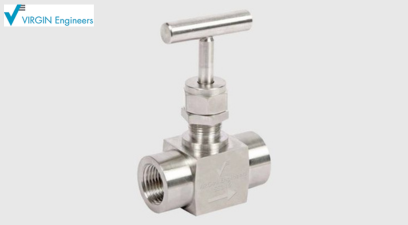
Needle valves control flow position with a tapered pin that passes through a conical seat, providing the operator with excellent regulation of gas and liquid lines. The two grades, Titanium Grade 2 Needle Valves and Titanium Grade 5 Needle Valves, are most suitable for specifying this duty and are applicable to different pressure and corrosion environments. Choosing the right grade will affect reliability, service life, and cost of operation over time.
Understanding Titanium Grade 2 and Grade 5
Titanium Grade 2
Grade 2 is a commercially pure titanium, around 99% titanium, with mild residual oxygen and iron. Its tensile strength ranges from 345 MPa to 515 MPa, with a 275 MPa minimum yield strength. Elongation is approximately 20%, which contributes to high ductility and formability. So a Titanium Gr 2 Needle Valve is well suited to moderate-pressure instrumentation applications where corrosion resistance is the most important consideration.
Titanium Grade 5 (Ti-6Al-4V)
Grade 5 is an alpha-beta alloy containing about 6% aluminium and 4% vanadium. Minimum tensile strength reaches 895 MPa, roughly two and a half times that of Grade 2, with yield strength above 828 MPa. Fatigue resistance improves substantially under cyclic loading. A Titanium Grade 5 Needle Valve performs better in demanding industrial environments where mechanical stress and vibration are constant factors.
Titanium Grade 5 vs Grade 2 Needle Valves: Key Differences
Titanium Grade 2 and Grade 5 differ mainly in strength, weight, and cost. The right choice depends on pressure demands, corrosion exposure, and fabrication requirements for your application.
| Property | Grade 2 | Grade 5 | Why It Matters |
| Material Type | Commercially pure titanium | Ti-6Al-4V alloy | Alloying with aluminium and vanadium adds strength that Grade 2 lacks. |
| Tensile Strength | 345–515 MPa | 895 MPa minimum | Grade 5 withstands more than double the load before failure. |
| Pressure Handling | Moderate | High | Grade 5 handles high-pressure lines; Grade 2 suits low-stress systems. |
| Weight | 4.51 g/cm³ density | 4.43 g/cm³ density | Grade 5 stays lighter despite its added strength. |
| Corrosion Resistance | Excellent | Very good | Grade 2 resists chlorides and seawater slightly better. |
| Fatigue Resistance | Moderate | High | Grade 5 holds up longer under repeated stress cycles. |
| Machinability | Easier to form and weld | Harder, needs more tooling | Grade 2 cuts fabrication time and tooling costs. |
| Cost | Lower | Higher | Grade 2 suits tight budgets; Grade 5 justifies cost in critical service. |
| Typical Applications | Chemical processing, marine systems | Offshore, aerospace, high-pressure lines | Match the grade to load requirements, not application alone. |
The tensile strength is the internal pressure that a valve body can withstand prior to plastic deformation. Fatigue resistance determines life under repeated cycling pressure, an important consideration for offshore and aerospace systems where vibration is constant. Service life is impaired by corrosion in aggressive chemical or marine environments and the Grade 2 purity gives it an advantage over the alloyed structure of Grade 5.
When Should You Choose a Titanium Grade 5 Needle Valve?
The strength margin of Grade 5 is favourable for high-pressure instrumentation systems, especially in the offshore oil and gas industry, which is subjected to continuous vibration. The strength-to-weight ratio of the alloy is well supported in aerospace hydraulic systems, as a lighter valve body decreases the overall system mass without compromising the pressure rating. Industrial High Cycle Processes – if your valves open and close thousands of times per shift, you need the superior fatigue resistance of Grade 5. Titanium Gr 5 Needle Valve selections make sense wherever mechanical loading and vibration combine.
When Is Grade 2 the Better Choice?
Corrosive chemical process lines choose Grade 2 for its oxide layer that protects the metal from acid and chloride damage. Marine water equipment, pharmaceutical and water treatment applications operate at pressures where the additional strength of Grade 5 provides no practical advantage. The features of the Titanium Grade 2 Needle Valve also suit low- to medium-pressure instrumentation and budget applications.
Final Selection Tips
Operating pressure establishes the minimum strength requirement before any other factors are considered. Exposure to corrosion imposes additional constraints on the selection of materials, particularly in the presence of high levels of chlorides or acids. Mechanical loading, such as vibrating or cyclic running, also has a tendency to promote Grade 5. The end decision should be influenced by maintenance expectations and life cycle cost rather than the first cost. Consulting an experienced manufacturer before specifying a valve grade helps avoid costly rework later.
Conclusion
Titanium Grade 5 vs. Grade 2 Needle Valves is a comparison based on the material properties of the two types of titanium needle valves for use in specific conditions. Grade 5 is appropriate for high-pressure, high-cycle, or weight-sensitive applications, but Grade 2 is still a feasible option for corrosive, low-pressure service. Virgin Engineers produces both grades in-house and can assist in the selection of the right specification for an application.