
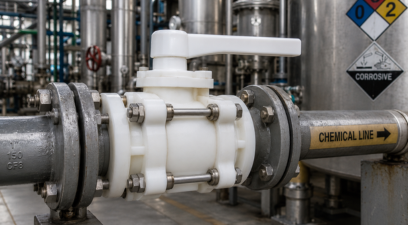
A chemical plant runs on flow control. Get a valve wrong, and the result is a leak, a shutdown, or worse. Corrosive acids, aggressive solvents, and reactive process fluids destroy standard valve materials within months, sometimes weeks, which is why material selection sits at the centre of every piping design decision in this industry. PTFE ball valves have become the preferred choice for handling aggressive process media because PTFE resists chemical attack that rapidly degrades conventional metal seats and elastomer seals. Their sealing performance, corrosion resistance, and long working life protect both uptime and safety on the plant floor.
What Are PTFE Ball Valves?
A PTFE ball valve uses a spherical bore ball to control flow, but the seats, seals, or sometimes the full flow path is lined or built with polytetrafluoroethylene. PTFE brings near-universal chemical inertness and does not react with most acids, alkalis, or solvents passing through it. In a PTFE-lined or PTFE-seated design, the metal body carries structural strength and pressure containment while PTFE manages the contact surface with the process fluid.
Key Components of PTFE Ball Valves
Three parts do the real work in these valves.
PTFE seats and seals sit against the ball to create the shut-off surface. They do not swell or degrade on contact with solvents or acidic media, which keeps the seal tight across repeated cycles.
The ball, stem, and valve body form the structural core. The ball rotates within the body to open or block flow, the stem transmits actuation torque, and the body carries the pressure rating of the assembly.
The operating mechanism connects the handle or actuator to the stem. A quarter turn moves the ball from fully open to fully closed.
Why PTFE Ball Valves Are Widely Used in Chemical Processing Industries
Chemical resistance is not optional in most process lines. A valve seat that swells or cracks after contact with a solvent creates a leak path, and leak paths in a chemical plant are never a small problem. PTFE holds its shape and sealing capability across a broad range of aggressive fluids, keeping the valve functional through continuous operation. This protects product integrity too, since contaminated batches from a degrading seal cost more in rework and downtime than the valve itself.
Key Features That Make PTFE Ball Valves Essential
A handful of properties explain why engineers keep specifying this valve type across chemical process lines.
Excellent Chemical Corrosion Resistance
PTFE holds up against acids, alkalis, and most industrial solvents without pitting, swelling, or breakdown, which matters most in lines carrying concentrated reagents.
Superior Leak-Tight Sealing Performance
The soft, low-friction PTFE surface conforms tightly against the ball, closing off flow completely on shut-off. In hazardous fluid service, this seal separates a controlled process from an emergency.
High Temperature and Pressure Resistance
PTFE seated valves operate reliably across demanding temperature and pressure ranges. Standard PTFE handles service up to approximately 200°C, covering most chemical processing conditions.
Low Friction and Smooth Operation
PTFE has one of the lowest coefficients of friction among engineering plastics. This lowers operating torque, giving smoother actuation and less strain on the stem over years of cycling.
Long Service Life with Minimal Maintenance
Because PTFE does not degrade quickly under chemical exposure, seat replacement intervals stretch out, lowering operating cost over the plant’s life.
Applications of PTFE Ball Valves in Chemical Processing Plants
These valves show up across several segments of the chemical and process industry, each with its own demands on the seat material.
Chemical manufacturing facilities run PTFE ball valves on lines carrying acids, solvents, and reactive intermediates where standard elastomer seals fail quickly.
Petrochemical processing units use them in hydrocarbon streams and chemical additive lines, where pressure rating and chemical compatibility both matter.
Pharmaceutical production depends on non-reactive flow paths to keep product purity intact, and PTFE’s inert surface fits that need directly.
Water and wastewater chemical treatment systems handle chlorine, acids, and caustics for dosing and disinfection; PTFE media tolerate them well.
Fertiliser and speciality chemical plants work with ammonia and phosphoric acid, where seat degradation is a recurring failure point without PTFE.
How PTFE Ball Valves Improve Process Safety and Efficiency
Safety and efficiency trace back to how well the valves hold their seal under real operating stress.
Preventing Chemical Leakage
A tight PTFE seat stops hazardous fluid from escaping the flow path, a direct safety requirement in lines carrying toxic or flammable media.
Reducing Equipment Downtime
Valves that hold their seal without frequent rebuilds keep the process line running, cutting disruptions to batch schedules.
Supporting Product Purity
PTFE does not shed particles or react with the process fluid the way some elastomers do, keeping contamination risk low in sensitive downstream lines.
Factors to Consider When Selecting PTFE Ball Valves
Choosing the right valve for a given line comes down to a few technical checks before specification.
Chemical Compatibility
Match the valve material, seat, seal, and body against the exact process media and its concentration. A material fine for a dilute acid may fail against the concentrated form.
Operating Temperature and Pressure
Confirm the valve’s rated temperature and pressure against actual system conditions, including startup and upset scenarios.
Valve Size and End Connections
The bore size and connection type, flanged, threaded, or welded, need to match the existing piping specification.
Industry Standards and Quality Requirements
Verify the valve meets applicable industrial specifications and certifications, particularly in regulated sectors like pharmaceuticals.
Common Challenges PTFE Ball Valves Help Overcome
Process engineers deal with a recurring set of valve-related failures. Corrosion-related failures drop sharply once PTFE replaces standard elastomer or metal seats in aggressive service. Leakage in aggressive chemical applications reduces because PTFE does not swell or crack on contact with solvents. Frequent maintenance due to material degradation becomes less frequent as PTFE retains its properties over longer exposure, and reduced equipment life becomes less of a concern with seat material that can withstand the conditions that cause early failure.
Best Practices for Maximizing the Performance of PTFE Ball Valves
Getting long service life out of these valves depends on how they are installed and run, not just the material choice.
Proper Installation Procedures
Align the valve correctly within the piping run and mount it securely. Misalignment stresses the stem and seat unevenly, shortening service life early.
Routine Inspection and Preventive Maintenance
Check seals and the operating mechanism on a scheduled basis. Catching early wear before it becomes a leak keeps unplanned downtime off the log.
Operating Within Recommended Service Limits
Stay within the valve’s rated pressure and temperature range. Pushing past these limits, even briefly during an upset, accelerates seat wear.
Conclusion
Reliable flow control in a chemical plant is heavily dependent on valve material selection, and PTFE ball valves address this head-on, with their resistance to corrosive media, tight sealing performance, and long service life. They reduce the risk of leakage, reduce unplanned maintenance, and maintain product purity across demanding process conditions. Selecting the correct PTFE ball valve for a given application, matched against chemical compatibility, temperature, pressure, and connection requirements, improves process safety and equipment lifespan. Virgin Engineers manufactures and supplies PTFE ball valves engineered for chemical processing service. Explore the range here.