
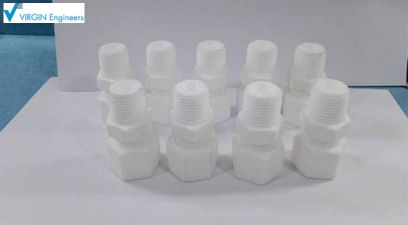
Fluid handling systems fail most often at the connection point, not the pipe itself. Choosing fittings that resist chemical attack and hold their seal under heat separates a system that runs for decades from one that leaks within months. PTFE tube fittings solve this because the material stays chemically inert against nearly every industrial fluid and holds performance where standard metal seals would degrade. Engineers handling aggressive media often specify high temperature PTFE fittings for exactly this reason. This guide walks through the factors that decide whether a fitting matches your application or fails it.
What Are PTFE Tube Fittings?
PTFE tube fittings are connectors machined from polytetrafluoroethylene, a fluoropolymer known for its non-reactive surface and near-zero friction coefficient. Unlike stainless steel or brass fittings, PTFE will not corrode, pit, or react with acids, solvents, or caustic chemicals passing through the line. That single property changes how an engineer specs an entire system. Fittings arrive in compression, elbow, tee, union, and straight configurations, sized to match tube outer diameters from ⅛″ to 2″. Most manufacturers build them to ASTM D1710 and D4894 material standards, which govern purity and mechanical consistency for industrial use.
Why Choose PTFE Tube Fittings?
Chemical resistance tops the list. PTFE fittings withstand exposure to strong acids, alkalis, and solvents without swelling or breaking down at the molecular level. Operating temperature range extends from -200°C to 260°C continuous service, covering cryogenic lines and high-heat process loops in the same material family. The surface carries a friction coefficient near 0.05, so fluids move through with minimal drag and no particulate shedding into sensitive process lines. Weight matters too. A PTFE fitting runs roughly one-fifth the mass of an equivalent brass part, cutting installation time on long tube runs.
Key Factors to Consider When Choosing PTFE Tube Fittings
Matching the fitting to your process starts with these checks before ordering.
- Chemical compatibility with the process media determines seal life more than any other single variable.
- Operating temperature range must cover both steady-state flow and any startup or purge cycle extremes.
- Pressure ratings need a margin above peak system pressure, not just average operating pressure.
- Tube size and fitting dimensions must match OD tolerances exactly to prevent seal creep over time.
- Connection type (compression, flare, or bulkhead) depends on how the line will be serviced later.
- The installation environment, including vibration, UV exposure, and ambient temperature, affects long-term fitting integrity.
- Industry certifications such as FDA or USP Class VI apply directly to pharma and food lines.
- Maintenance access should factor into fitting choice if disassembly happens on a regular schedule.
Types of PTFE Tube Fittings
Each configuration below suits a specific point in a tube run, from straight joins to branch connections.
PTFE Compression Tube Fittings
These use a ferrule system to grip the tube without heat or adhesive, giving a leak-proof joint rated to full line pressure.
PTFE Elbow Fittings
Elbows redirect flow at 45° or 90° angles in tight enclosures where a straight run cannot fit between components.
PTFE Tee Fittings
Tees split or combine flow across three tube ends, common in sampling loops and multi-branch chemical feed systems.
PTFE Union Fittings
Unions join two tube ends of matching size, allowing disassembly for cleaning without cutting the tube line.
PTFE Straight Fittings
Straight connectors extend a run or transition between two fitting types along an unobstructed length of tube.
PTFE Pipe Fittings
PTFE pipe fittings thread directly into pipe-sized ports, bridging tube systems with standard NPT or BSP pipework.
Bulkhead PTFE Fittings
Bulkhead fittings pass tube lines through a panel or tank wall while maintaining a sealed, pressure-rated boundary.
PTFE Tube Connectors
General-purpose connectors adapt between differing tube sizes or materials within the same process loop.
Industrial Applications of PTFE Fittings
Industries running corrosive or high-purity media rely on Teflon tube fittings across the following sectors.
Chemical Processing Plants
Acid and solvent transfer lines use PTFE fittings to prevent contamination and eliminate corrosion-driven leak points over the years of service.
Pharmaceutical Industries
Purity-critical lines depend on PTFE pipe fittings that shed no particulates and meet USP Class VI biocompatibility standards.
Water Treatment Systems
Chlorine and ozone dosing lines need fittings that resist oxidation without degrading seal performance across variable flow rates.
Semiconductor Manufacturing
Ultra-pure chemical delivery in wafer fabrication demands zero-leach fittings, since even trace contamination affects yield.
Food and Beverage Processing
Sanitary lines use PTFE for its non-stick surface, which resists bacterial adhesion and simplifies CIP cleaning cycles.
Laboratories and Research Facilities
Analytical instruments route reactive samples through PTFE tubing to avoid cross-contamination between test runs.
Petrochemical Industries
High-pressure hydrocarbon lines use PTFE-sealed fittings where metal gaskets would fail under sustained chemical exposure.
Medical and Biotechnology Applications
Biocompatible tubing in diagnostic and drug-delivery equipment relies on PTFE for its inert, sterilisable surface.
Common Mistakes to Avoid While Selecting PTFE Fittings
Small specification errors at the ordering stage often surface as leaks months into operation.
- Ignoring chemical compatibility with trace additives or cleaning agents used alongside the primary process fluid.
- Selecting incorrect fitting sizes based on nominal tube size rather than the actual measured outer diameter.
- Overlooking pressure and temperature ratings during startup transients, not just steady-state operating conditions.
- Use a compression fitting where a bulkhead or union type is more suitable for the installation.
- Ignoring installation environment factors like vibration, which loosens ferrules over repeated thermal cycling.
- Not planning for occasional seal inspection. PTFE parts require very little maintenance for years.
Benefits of PTFE Compression Tube Fittings
Compression-style fittings deliver specific advantages worth weighing against other connection types.
Fast Installation
There is no requirement for soldering, welding or special tools, which greatly reduces installation time on multi-point tube runs.
Excellent Sealing Properties
The cold-flow characteristic of PTFE allows the ferrule to adapt to small imperfections in the tube surface that metal seals cannot.
High Resistance to Aggressive Chemicals
Unlike elastomer-sealed versions that degrade over time, strong acids and solvents pass through without degrading the seal.
Suitable for High-Purity Applications
Zero particulate shedding keeps semiconductor and pharma lines within contamination specifications across long service intervals.
Reliable Performance in Demanding Environments
Vibration, thermal cycling, and pressure fluctuation are absorbed without the seal degradation common in rigid metal joints.
Conclusion
Selecting the right PTFE fittings comes down to matching chemical compatibility, temperature range, and connection type to the actual demands of your line. Their resistance to corrosion and low-maintenance service life make them the practical choice for chemically aggressive or high-purity systems. Virgin Engineers manufactures this range across sizes engineered for exactly these applications.