
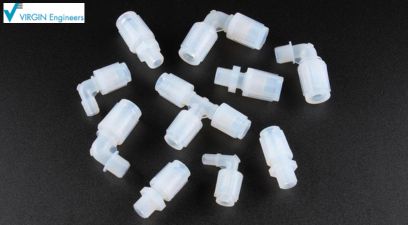
When dealing with hazardous fluids, corrosive process chemicals eventually damage standard metal fittings. Chemical plants, pharmaceutical plants, and semiconductor fabs all require connectors that will withstand acids, solvents, and alkalis without separating toxins. PTFE’s chemical resistance, wide range of temperature tolerance, and non-reactive surface chemistry accomplish this goal. Engineers designing industrial PTFE fitting solutions depend on these characteristics to avoid rust-related failures. This article discusses the types, properties, and applications that engineers use in choosing them.
What Are Teflon Tube Fittings?
PTFE (Polytetrafluoroethylene) forms the base material for Teflon tube connectors, a fluoropolymer built from carbon-fluorine bonds carrying a dissociation energy near 485 kJ/mol, one of the strongest in organic chemistry. That bond strength is why PTFE resists chemical attack that dissolves or oxidizes most metals. Unlike stainless steel or brass fittings, PTFE fittings never rust or leach metal ions into process fluid, a factor that matters where trace contamination fails a batch. Fittings ship in standard sizes from 1/8 inch to 1 inch OD, with metric equivalents from 3mm to 25mm, built to ASTM D1710 and D1457 standards.
Types of Teflon Tube Fittings
Eight geometries cover most PTFE tubing layouts:
- PTFE Tee Fittings: Diverts or combines flow from three lines, common at sampling points.
- PTFE Union Fittings: Join two ends of tubes of the same diameter for repairs or extensions.
- PTFE Straight Connectors: Connect tubes to drilled ports on pumps, valves, or equipment.
- PTFE Tube Connectors: can accommodate piping types or wall thicknesses in one system.
- PTFE Reducer Fittings: Reduce from larger to smaller diameters without sharp, turbulence-inducing transitions.
Key Properties of Teflon Tube Fittings
PTFE tube fittings maintain performance across a service range of -200°C to +260°C without cracking or softening, which is why few plastics or steels work well in one material. Chemical resistance covers nearly the full pH scale against concentrated acids, strong alkalis, and most organic solutions, with failure being seen only against molten alkali metals and elemental fluorine at elevated temperatures. A low factor of friction, between 0.05 and 0.10, reduces particulate shedding in high-purity lines. The material holds a conductive strength around 60 kV/mm and resists damage from UV exposure over years of outdoor service.
Benefits of Using PTFE Tube Fittings
Process engineers choose PTFE fittings for lines that use highly concentrated sulfuric acid, sodium hydroxide, or chlorinated solvents, media that pit metal fittings within weeks. The solid surface prevents ion draining, protecting pharmaceutical and semiconductor processes from contamination that would destroy a batch. As these fittings do not require passivation or a corrosion inspection schedule, maintenance decreases accordingly. They assemble faster and cut load on panel-based runs around 1/6 the density of stainless steel. The sealing surface also adjusts slightly when compressed, closing small gaps that rigid metal seats can’t match.
Industrial Applications of Teflon Tube Fittings
Chemical processing plants use Teflon pipe fittings throughout acid transfer and solvent recovery lines where metal alternatives fail within a single maintenance cycle. Pharmaceutical manufacturers depend on PTFE tube connectors in water-for-injection systems since the material meets USP Class VI biocompatibility requirements. Water treatment plants route chlorine dioxide and ozone through PTFE fittings to avoid the corrosion chlorine causes in brass and steel. Food and beverage lines use them in clean-in-place systems exposed to caustic wash cycles, while semiconductor fabs specify them for ultrapure water delivery, where trace metal contamination can ruin a wafer batch. Petrochemical, laboratory, and biotech lines round out the core application base.
Factors to Consider When Choosing Teflon Tube Fittings
Chemical compatibility comes first. Verify the exact concentration and temperature of the process fluid against published resistance data before specifying. Operating pressure and temperature ratings follow directly. PTFE compression fittings are generally rated for 150-200 PSI at room temperature, with reversible curves that reduce the allowable pressure as the service temperature increases to 260°C. The tube outer diameter and wall thickness must be exactly the same as the ferrule bore; a variance of just 0.5 mm will cause leaks under cycling.
Common Mistakes to Avoid
Specifying a fitting without checking chemical compatibility against the exact fluid concentration causes premature failures a datasheet check would prevent. Ignoring pressure and temperature derating ranks second; a fitting rated at 200 PSI ambient may only handle 50 PSI at 200°C. Undersized or oversized fittings relative to tube OD create seal gaps that leak under vibration. Using a straight connector where a bulkhead belongs, or a compression joint where a welded connection is needed, compromises the line’s integrity. Skipping ferrule torque checks lets fittings loosen under thermal cycling.
Conclusion
Teflon tube fittings connect fluid lines that carry chemicals strong enough to destroy metal hardware within one production cycle. Their -200°C to +260°C service range, broad chemical resistance, and non-toxic exterior chemistry make them a standard choice across chemical, pharmaceutical, and semiconductor industries. Virgin Engineers supplies PTFE fitting designs built around these specifications, offering process designers a corrosion-resistant fluid handling solution for demanding service conditions.